 AMINA Bank AG
 AMINA UK
  AMINA Hong Kong
  AMINA EU
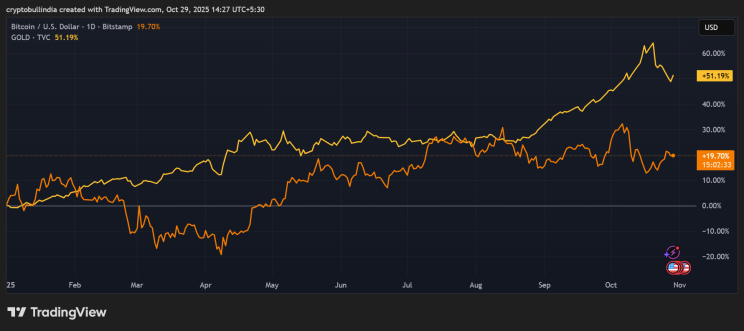
 A dramatic performance gap emerged between gold and Bitcoin over the past year—one that few anticipated. While Bitcoin returned nearly 19% between October 2024 and October 2025, gold soared almost 51% during the same period, reaching approximately $4,400 per ounce at its peak on October 17, 2025, and repeatedly breaking all-time highs. This stark divergence in returns challenges the conventional narrative about digital assets. Amid escalating geopolitical tensions and a shifting monetary landscape, the data tells a compelling story: gold has decisively outperformed ‘digital gold,’ reasserting its dominance as the world’s primary reserve asset.
Figure 1: Gold Outpaces Bitcoin on YTD basis
Source: TradingView
The scale of sovereign government demand for gold explains much of the movement. Central banks purchased roughly 244 tonnes of gold in Q1 2025, the second-highest quarterly total on record and nearly 24% above the five-year average. Poland increased its holdings to over 515 tonnes, bringing gold to around 22% of its reserve composition. Turkey added approximately 19.5 tonnes amid currency depreciation pressures. China continued to accumulate gold while reducing exposure to US Treasuries, and trading activity on the Shanghai Gold Exchange expanded significantly, creating alternative depth in global pricing mechanisms.
This pattern reflects a shift in how reserve safety is defined. Gold carries no sovereign promise, no maturity schedule and no political jurisdiction. For reserve managers navigating a fragmented international system, these characteristics are increasingly decisive.
Market behaviour reinforces this structural argument. S&P 500’s rolling one-year correlation with the Gold has averaged around 21%, compared with approximately 46% for Bitcoin, which has traded more like a high-beta growth asset. Gold and Bitcoin have shown only about 10% correlation with one another over the same interval, indicating that — despite the “stores of value” narrative — they respond to fundamentally different demand drivers.
In crisis environments, gold’s history also provides evidence where Bitcoin’s remains incomplete. Across the worst one-in-twenty among the last 50 years in equity markets since the mid-1970s, the S&P 500 has declined roughly 25% while gold has delivered average gains of approximately 2%. Bitcoin has not yet experienced an equivalent breadth of monetary, geopolitical and liquidity cycles to establish comparable defensive credentials.
Monetary policy has additionally supported gold. Since mid-2024, the Federal Reserve has cut policy rates by roughly 100 basis points, decreasing the opportunity cost of holding non-yielding assets. Statistical models linking gold performance to the two-year Treasury yield indicate that easing cycles tend to create favourable return environments for Gold, with roughly 48% explanatory power.
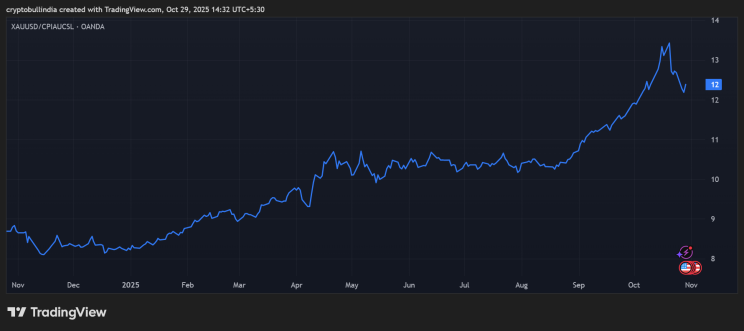
There is also a valuation consideration. The ratio between the price of gold to CPI reached near-record levels in 2025, rising from around 8.5 to approximately 12.2 year-on-year (as of 28 October 2025). However, gold is not being valued solely as an inflation hedge in the current cycle. It is being priced as a politically neutral reserve asset in a multipolar monetary system, which changes the interpretation of valuation metrics derived from past inflation-driven cycles.
Figure 2: Gold to CPI ratio has increased from 8.5 to 12.2 in last 1 year
Source: TradingView
The question for investors, then, is not whether gold remains essential. It is in which format gold should be held.
The Spectrum of Gold Ownership and Its Trade-Offs
Gold can be held through a range of instruments, each balancing security, liquidity and operational practicality differently.
Physical bullion offers clear direct ownership but comes with the need for secure storage, insurance and periodic verification. It is effective for long-term wealth preservation, yet structurally unsuitable for frequent liquidity or settlement.
Allocated gold accounts provide institutional-grade custody of specifically identified bars, fully insured and segregated, but typically involve larger minimums and less transactional flexibility.
Unallocated accounts offer low cost and deep liquidity but represent claims on a pool of metal rather than direct title. Counterparty exposure becomes the primary risk variable.
Gold ETFs introduced broad accessibility and exchange liquidity; however, ETF units represent financial claims, not legally owned metal. Redemption into physical form is limited and operationally complex for most holders.
Mutual funds and structured gold investment products may track gold indirectly through miners or ETF baskets, and performance can deviate materially from spot price.
Digital gold platforms reduce minimum investment thresholds, allowing fractional holdings, but rely on centralised custodians. Proof of reserves is typically opaque and contingent on the solvency of the issuing platform.
Gold futures markets enable tactical exposure and hedging but rarely result in physical settlement. They serve traders rather than holders seeking reserve certainty.
Across these formats, the pattern is consistent. Instruments offering clear ownership are operationally burdensome; instruments that are simple to use introduce layers of abstraction and counterparty reliance.
This is the structural gap that tokenised gold addresses.
Tokenised Gold: Ownership with Practicality
Tokenised gold represents specific quantities of physical gold stored in regulated vaults, where ownership is recorded on a blockchain ledger. The token itself constitutes the legal title to the underlying metal. This removes the historical trade-off between custody certainty and ease of use.
Ownership is direct rather than representational. Transfers settle globally, often within minutes. Verification does not depend on institutional reporting but on cryptographic proof and third-party audit. Fractionalisation is inherent, enabling position sizes from grams to tonnes without structural difference in integrity.
Tokenisation does not change what gold is; it changes what can be done with gold.
Gold becomes not only a store of value, but a liquid reserve asset that can move across banking systems, custodial networks and national borders without operational friction.
This is where the AMINA Gold Token is positioned.
AMINA Gold Token: Institutional-Grade Tokenised Gold at the Refinery
The AMINA Gold Token (ticker: SGT) represents direct ownership of 1 gram of 100% fine gold stored at the Argor-Heraeus refinery in Switzerland. This is not a financial claim, nor a pooled entitlement. It is legally recognised co-ownership of specific physical gold, available exclusively for AMINA clients. It is recorded on-chain, with AMINA Bank, a fully licensed Swiss bank regulated by FINMA, issues, custodies and manages the tokenisation process.
By anchoring ownership at the refinery rather than in post-refinery vault networks, SGT removes the traditional storage, handling and insurance cost structure. There is no ongoing physical storage fee. Digital custody is charged at institutional rates of approximately 0.25–0.30% per annum, depending on position size, creating a significantly lower cost of long-term ownership than conventional allocated structures or ETFs once fees are considered.
AMINA Gold Token is accessible in USD and major G20 currencies, as well as BTC and ETH. It can be redeemed for physical delivery if required. Transfers occur through standard ERC-20 settlement rails, allowing SGT to move between traditional finance and digital asset markets with equal fluidity.
The defining characteristic is that SGT allows gold to operate as a useful reserve instrument. It retains the wealth preservation profile of allocated bullion yet trades with the immediacy and borderlessness of digital assets. It is suitable for portfolio diversification, cross-system settlement, collateralisation, and defensive liquidity management.
In a financial environment where sovereignty, jurisdiction and settlement infrastructure are increasingly strategic variables, SGT offers a form of gold ownership aligned with the realities of modern capital movement, rather than the operational constraints of the twentieth century bullion system.
Gold’s role as a reserve store of value is strengthening. Tokenisation does not reinvent that role. It restores gold’s most fundamental characteristic: a neutral, portable, universally recognised asset that does not depend on the credit of any institution.
AMINA Gold Token is gold in the form required for the financial system that is now emerging.
Conclusion
The divergence between gold and Bitcoin over the past year has not been a matter of sentiment or narrative preference. It reflects a deeper reassessment of what constitutes a reliable reserve asset at a time when geopolitical alignments are shifting and the structure of the global monetary system is evolving. Central banks have made this clear through sustained and accelerating purchases. Portfolio correlations have reinforced the message. Gold continues to function as the asset investors turn to when the stability of institutions, currencies or financial systems is uncertain.
At the same time, the way gold is held is undergoing its own transformation. Traditional forms of ownership provide security but are slow and operationally rigid. Financialised exposures offer convenience but introduce abstraction and counterparty dependence. The market has lacked a structure that combines certainty of titles with the ability to move and transact efficiently across borders and platforms.
Tokenised gold closes that gap. It restores the sovereignty of holding physical metal while enabling settlement and transfer at the speed of modern financial systems. What is emerging is not a new asset, but a new interface for one of the oldest. Gold remains gold, but the mechanisms for accessing, storing and deploying it are becoming more aligned with the realities of contemporary capital mobility.
In a world where resilience and flexibility are increasingly strategic requirements, the evolution of gold from static reserve to dynamic, transferable store of value marks a fundamental change in how the asset participates in portfolios and financial architecture. The asset itself has not changed. What has changed is our ability to use it.
Disclaimer
This document has been prepared by AMINA Bank Ltd. (“AMINA”) in Switzerland. AMINA is a Swiss licensed bank and securities dealer with its head office and legal domicile in Switzerland. It is authorized and regulated by the Swiss Financial Market Supervisory Authority (“FINMA”).
This document is published solely for educational purposes; it is not an advertisement nor a solicitation or an offer to buy or sell any financial investment or to participate in any particular investment strategy. This document is for publication only on AMINA website, blog, and AMINA social media accounts as permitted by applicable law. It is not directed to, or intended for distribution to or use by, any person or entity who is a citizen or resident of or located in any locality, state, country or other jurisdiction where such distribution, publication, availability or use would be contrary to law or regulation or would subject AMINA to any registration or licensing requirement within such jurisdiction.
Research will initiate, update and cease coverage solely at the discretion of AMINA. This document is based on various sources, incl. AMINA ones, and was generated using artificial intelligence (“AI”). No representation or warranty, either express or implied, is provided in relation to the accuracy, completeness or reliability of the information contained in this document, except with respect to information concerning AMINA. The information is not intended to be a complete statement or summary of the subjects alluded to in the document, whereas general information, financial investments, markets or developments. AMINA does not undertake to update or keep current information. Any statements contained in this document attributed to a third party represent AMINA’s interpretation of the data, information and/or opinions provided by that third party either publicly or through a subscription service, and such use and interpretation have not been reviewed by the third party.
Any formulas, equations, or prices stated in this document are for informational or explanatory purposes only and do not represent valuations for individual investments. There is no representation that any transaction can or could have been affected at those formulas, equations, or prices, and any formula(s), equation(s), or price(s) do not necessarily reflect AMINA’s internal books and records or theoretical model-based valuations and may be based on certain assumptions. Different assumptions by AMINA or any other source may yield substantially different results.
Nothing in this document constitutes a representation that any investment strategy or investment is suitable or appropriate to an investor’s individual circumstances or otherwise constitutes a personal recommendation. Investments involve risks, and investors should exercise prudence and their own judgment in making their investment decisions. Financial investments described in the document may not be eligible for sale in all jurisdictions or to certain categories of investors. Certain services and products are subject to legal restrictions and cannot be offered on an unrestricted basis to certain investors. Recipients are therefore asked to consult the restrictions relating to investments, products or services for further information. Furthermore, recipients may consult their legal/tax advisors should they require any clarifications.
At any time, investment decisions (including, among others, deposit, buy, sell or hold investments) made by AMINA and its employees may differ from or be contrary to the opinions expressed in AMINA research publications.
This document may not be reproduced, or copies circulated without prior authority of AMINA. Unless otherwise agreed in writing, AMINA expressly prohibits the distribution and transfer of this document to third parties for any reason. AMINA accepts no liability whatsoever for any claims or lawsuits from any third parties arising from the use or distribution of this document.
©AMINA, Kolinplatz 15, 6300 Zug