 AMINA Bank AG
 AMINA UK
  AMINA Hong Kong
  AMINA EU
 As crypto adoption continues to grow, so does the need for different ways to securely store it. There are multiple crypto custody options, each designed for different types of investors and needs.
The three main types of crypto custody you’ll come across are self-custody, third-party custody, and hybrid custody. But what really sets them apart? And more importantly, which one makes sense for the way you hold and use your crypto?
In this article, we break down how each custody type works, along with the benefits, risks, and challenges.
Self-Custody
In a self-custody model, you hold your own private keys (typically managed via a recovery seed phrase), thus retaining full control and complete ownership of your crypto. It’s the preferred choice if you value independence and privacy, as you manage your assets without relying on any third party. The benefits and tools required to avail self-custody are given below.
Benefits of self-custody and available tools
1. Hardware wallets: These wallets are physical devices that store your private keys offline, making them one of the most secure options as they remain isolated from online threats.
2. Software wallets: This type of wallet is a mobile or desktop application connected to the internet, offering greater convenience for frequent transactions, often used alongside additional security measures for safer usage.
3. Paper wallets: These wallets take a completely offline approach, where your keys are written or printed on paper. While this removes digital risks entirely, it introduces practical challenges, as the paper can be lost, damaged, or difficult to use for regular transactions.
Challenges with self-custody
Self-custody offers control, but it also puts the entire responsibility on you.
- Security risks: If your private keys are lost or compromised (e.g., phishing or malware), there’s no way to recover your funds.
- Technical know-how: You need a solid understanding of wallets, device security, and common cyber threats.
- Backup and recovery: Safely storing recovery phrases is critical to avoid permanent loss.
- Storage discipline: Whether digital or physical, secure storage practices are essential to prevent theft or damage.
Third-Party Custody
In a third-party custody model, you entrust your crypto assets to a specialist provider—such as a crypto bank, crypto exchange, or regulated financial institution—that manages and secures them on your behalf. This approach is widely used by institutions and high-net-worth individuals who prefer the added security, compliance, and operational support that comes with working with established players. Increasingly, even traditional banks are stepping into this space to serve clients looking to diversify into digital assets.
Benefits of third-party custody
Entrusting your assets to a professional crypto custody provider can simplify operations while strengthening security in the following ways.
- Professional security standards: Crypto custody providers use advanced security protocols like multi-signature wallets, hardware security modules (HSMs), and cold storage to safeguard assets, significantly reducing the risks associated with self-management.
- Insurance coverage: Many providers offer insurance against specific risks such as cyber theft or internal fraud, giving you an added layer of financial protection. The level of insurance varies with each provider.
- Regulatory compliance: Custody providers operating within regulated frameworks follow established standards, which is especially important for institutions with compliance obligations.
- Operational ease: By handling the technical and security complexities, custodians make it easier to manage assets. For institutional clients, this often includes reporting tools, compliance support, and dedicated account management.
Challenges of third-party custody
- Reduced control: You rely on the custodian to manage your assets, which means giving up direct control over private keys.
- Counterparty risk: If the custody provider faces financial, operational, or security issues, your assets could be exposed.
- Fees: Custodial services typically involve crypto custody fees based on asset size and service scope, which may not suit all investors.
Hybrid Custody
Hybrid custody sits between self-custody and third-party custody, combining elements of both control and security. In this model, you and the custody provider share responsibility for managing the assets, rather than one party having complete control over your assets.
In practice, hybrid custody often uses multi-signature wallets or co-managed access systems. This means you and the custodian hold separate keys, and transactions can only be authorised when both parties approve. It reduces the risk of relying entirely on a third party, while still benefiting from institutional-grade safeguards.
Another common approach is tiered access. Most assets are held securely in cold storage, while a smaller portion is made available in hot wallets for easier access. This allows you to transact when needed without compromising the security of your larger holdings.
Benefits of hybrid custody
Hybrid custody is designed to balance flexibility with strong security controls.
- Enhanced security: By combining multi-signature approvals with professional cold storage, hybrid models reduce single points of failure and strengthen overall asset protection.
- Greater control with access: You retain partial control over your assets, while still benefiting from the custodian’s infrastructure and security expertise.
- Built-in risk mitigation: Even if one key is compromised, transactions cannot be executed without the other party’s approval, adding an extra layer of protection.
- Customisable setup: Hybrid solutions can be tailored to your needs, making them suitable for when you require both secure storage and periodic access to funds.
Challenges of hybrid custody
While flexible, hybrid custody introduces some additional complexity.
- Operational complexity: Multi-signature setups and shared access models can be harder to implement and manage, especially for less experienced users.
- Partial dependence: Although you retain some control, you still rely on the custodian for certain functions, which introduces counterparty risk.
- Higher costs: Custom setups and the infrastructure required to support hybrid models can result in higher crypto custody fees.
Self-Custody vs Third-Party vs Hybrid Custody
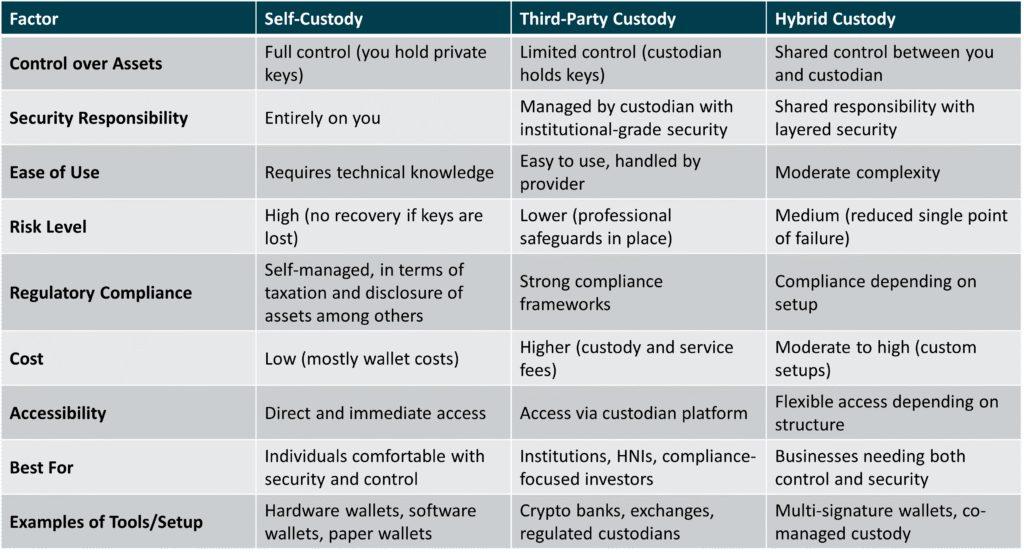
Source: AMINA Bank
Choosing the right custody provider
The right custody provider should combine strong security, operational reliability, and regulatory discipline. While no system is completely risk-free, certain fundamentals signal a trustworthy crypto custody partner.
- Security and resilience: Look for custodians that use robust security measures such as encryption, cold storage, and continuous monitoring, along with strong incident response and recovery plans to handle disruptions effectively.
- Data protection and compliance: Custodians should follow strict data security practices and comply with AML/KYC regulations across jurisdictions, ensuring both asset safety and regulatory alignment.
- Transparency and reporting: Clear reporting, auditability, proof-of-reserves attestations, and openness around security practices are essential. A lack of transparency can create unnecessary risk and uncertainty.
- Reputation and track record: Established custodians with a proven history of secure asset management and strong client trust are generally more reliable than newer or untested providers.
- Regulatory readiness: As regulations evolve, custodians must be able to adapt quickly while maintaining compliance with capital, reporting, and operational requirements.
Ultimately, the right custody model depends on your needs. Self-custody may suit individuals seeking control and privacy, third-party custody works well for institutions prioritising security and compliance, while hybrid models offer a balance of both for those needing flexibility.
That said, all models carry risks, including potential loss of assets, security breaches, and human error, which should be carefully considered before making a decision.
Conclusion
Crypto custody improves security, compliance, and ease of managing digital assets—but it isn’t without trade-offs. Risks like counterparty exposure, evolving regulations, security, and operational complexity still exist.
The key is understanding these factors and choosing a custody approach that fits your needs. With the right setup, crypto custody can become a reliable part of a broader digital asset strategy.
FAQs
Q1. What are the different types of custody in crypto?
The three main types are self-custody, third-party custody, and hybrid custody. Each offers a different balance of control, security, and convenience depending on how you want to manage your assets.
Q2. What are the different types of custodial wallets?
Custodial wallets are managed by a third party https://aminagroup.com/individuals/custody/, crypto bank, crypto exchange, or financial institution. These typically include hosted wallets linked to your account, where the provider manages private keys and security on your behalf.
Q3. Can I lose my crypto with a custodian?
While several risks related to crypto custody exist, regulated institutions may significantly reduce them through strong security protocols, audits, and operational controls. With crypto custody providers safeguard such as institutional-grade custody, compliance frameworks, and recovery processes help minimise the risk of permanent loss.
Q4. Can crypto assets be recovered once stolen?
In most cases, stolen crypto is difficult to recover due to the irreversible nature of blockchain transactions. However, regulated custodians may have controls, monitoring systems, and additional that can help mitigate losses or assist in recovery efforts where possible.
Q5. Which is better, a custodial or non-custodial wallet?
It depends on your needs. Non-custodial (self-custody) wallets offer full control and privacy, while custodial solutions provide stronger security, compliance, and ease of use. Institutions and large investors typically prefer custodial options, while individuals comfortable with security management may choose self-custody.
Disclaimer
This document has been prepared by AMINA Bank AG (“AMINA”) in Switzerland. AMINA is a Swiss licensed bank and securities dealer with its head office and legal domicile in Switzerland. It is authorized and regulated by the Swiss Financial Market Supervisory Authority (“FINMA”).
This document is published solely for educational purposes; it is not an advertisement nor a solicitation or an offer to buy or sell any financial investment or to participate in any particular investment strategy. This document is for publication only on AMINA website, blog, and AMINA social media accounts as permitted by applicable law. It is not directed to, or intended for distribution to or use by, any person or entity who is a citizen or resident of or located in any locality, state, country or other jurisdiction where such distribution, publication, availability or use would be contrary to law or regulation or would subject AMINA to any registration or licensing requirement within such jurisdiction.
Research will initiate, update and cease coverage solely at the discretion of AMINA. This document is based on various sources, incl. AMINA ones. In preparing this document, AMINA may have made limited use of artificial intelligence-enabled tools to assist with research, summarisation, and drafting, with all content subject to human review and validation.
No representation or warranty, either express or implied, is provided in relation to the accuracy, completeness or reliability of the information contained in this document, except with respect to information concerning AMINA. The information is not intended to be a complete statement or summary of the subjects alluded to in the document, whereas general information, financial investments, markets or developments. AMINA does not undertake to update or keep current information. Any statements contained in this document attributed to a third party represent AMINA’s interpretation of the data, information and/or opinions provided by that third party either publicly or through a subscription service, and such use and interpretation have not been reviewed by the third party.
Any formulas, equations, or prices stated in this document are for informational or explanatory purposes only and do not represent valuations for individual investments. There is no representation that any transaction can or could have been affected at those formulas, equations, or prices, and any formula(s), equation(s), or price(s) do not necessarily reflect AMINA’s internal books and records or theoretical model-based valuations and may be based on certain assumptions. Different assumptions by AMINA or any other source may yield substantially different results.
Nothing in this document constitutes a representation that any investment strategy or investment is suitable or appropriate to an investor’s individual circumstances or otherwise constitutes a personal recommendation. Investments involve risks, and investors should exercise prudence and their own judgment in making their investment decisions. Financial investments described in the document may not be eligible for sale in all jurisdictions or to certain categories of investors. Certain services and products are subject to legal restrictions and cannot be offered on an unrestricted basis to certain investors. Recipients are therefore asked to consult the restrictions relating to investments, products or services for further information. Furthermore, recipients may consult their legal/tax advisors should they require any clarifications.
At any time, investment decisions (including, among others, deposit, buy, sell or hold investments) made by AMINA and its employees may differ from or be contrary to the opinions expressed in AMINA research publications.
This document may not be reproduced, or copies circulated without prior authority of AMINA. Unless otherwise agreed in writing, AMINA expressly prohibits the distribution and transfer of this document to third parties for any reason. AMINA accepts no liability whatsoever for any claims or lawsuits from any third parties arising from the use or distribution of this document.
©2026 AMINA, Kolinplatz 15, 6300 Zug


