 AMINA Bank AG
 AMINA UK
  AMINA Hong Kong
  AMINA EU
Treasury allocations have typically gravitated towards cash, government securities, and debt instruments; assets chosen not for growth, but for predictability. The guiding principle has been simple: protect capital first, then optimise it. However, treasury allocations are now expanding beyond its their conventional boundaries.
Corporations and /institutions are undergoing one of their most significant evolutions in decades, where they are actively raising capital to acquire and manage digital assets as part of their balance sheets. Crypto is emerging as a legitimate part of corporate finances, which was historically deliberately conservative.
As crypto treasury matures, the question is no longer if digital assets belong on the balance sheet, but how they are being integrated. This blog explores some of the recent trends, tools, and tactics around crypto treasury for corporations.
Key takeaways
- Crypto treasury has moved from experimentation to a formal, balance sheet-driven strategy for corporations.
- Adoption is scaling: nearly 200 public companies now hold digital assets on their balance sheets.
- Stablecoins and digital assets are expanding beyond reserves into liquidity and payment use cases.
- Institutional infrastructure including custody, compliance, and reporting has matured to support enterprise adoption.
Crypto treasury trends in 2026
Crypto treasury has entered a period of rapid evolution. What started as a handful of companies experimenting with Bitcoin on the balance sheet has grown into a full ecosystem of capital-raising strategies, institutional participation, and dedicated infrastructure. The trends below trace how that transformation is playing out, and the tools and tactics that have emerged to support it.
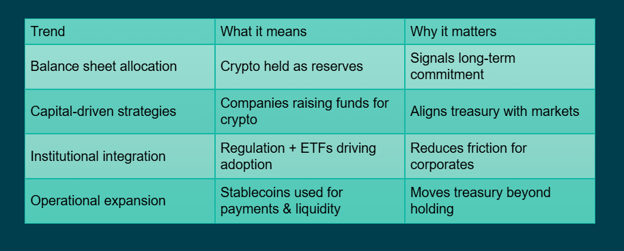
From experimentation to balance sheet allocation
As of January 2026, nearly 200 public companies worldwide held over $110 billion in digital assets as part of their treasury strategies. Furthermore, in early 2026, institutional demand, including exchange traded funds (ETFs) and major corporate treasuries such as Michael Saylor’s Strategy, was absorbing Bitcoin at 2.8 times the rate of new mining supply, a signal of sustained balance sheet allocation rather than short-term, tactical exposure.
That shift in scale has changed how companies fund their crypto holdings in the first place.
Treasury strategy is now capital-markets-driven
Rather than allocating surplus cash, corporates are increasingly raising capital specifically to acquire digital assets. This approach, pioneered at scale by Strategy, has involved equity issuances, debt financing, and structured instruments designed purely to fund Bitcoin accumulation. The model has gained traction across markets, with other companies raising billions to replicate similar strategies and align shareholder exposure directly with digital asset performance.
As more capital has flowed in through these markets-driven strategies, institutions themselves have followed — helped along by a regulatory and accounting backdrop that has finally caught up.
Institutional adoption is driving mainstream integration
According to Coinbase and EY-Parthenon, 86% of institutions either hold or plan to allocate funds to digital assets by the end of 2026, reflecting a clear shift toward mainstream adoption. Several regulatory and accounting developments have made this easier.
- Clearer accounting. U.S. GAAP introduced fair value rules for crypto assets, now in effect in 2026 reporting. Companies must show gains and losses in earnings, making crypto holdings more transparent in financial statements.
- Bank-level regulation.The Basel standards from the Bank for International Settlements (BIS) are now in force, setting limits on how much crypto exposure banks can take and requiring stronger risk controls for crypto-related activities.
- More regulated entry points. Developments like crypto ETFs and frameworks such as Europe’s MiCA (Markets in Crypto-Assets Regulation) have made it easier for institutions to access crypto through channels they already use, licensed institutions, stock exchanges, brokerage platforms, and regulated investment products.
Together, these developments are increasingly bringing crypto treasury into the same compliance and reporting frameworks as traditional assets — which has, in turn, opened the door to using crypto for more than just holding.
Liquidity and treasury operations are expanding beyond holding
Crypto treasury is no longer limited to holding Bitcoin or Ethereum. It now includes operational use cases, particularly through stablecoins, which are now used for cross-border payments, liquidity management, and working capital optimisation. Stablecoin market capitalisation exceeded $300 billion in April 2026, with growing transaction volumes across enterprise use cases with growing transaction volumes across enterprise use cases.
Surveys back up this shift: Flagship data says 13% of corporates already use stablecoins, and 58% plan to adopt them within the next two years. The implication is clear — crypto treasury is evolving from static allocation into active financial infrastructure.
Crypto treasury tools catching up with these trends
As crypto treasury trends in 2026 have taken shape, the tools supporting crypto treasury have evolved alongside them. In 2026, treasury teams are no longer relying on standalone wallets — they’re using integrated, institutional-grade platforms designed to match traditional finance standards, giving corporates the same control, governance, and visibility over digital assets that they already have over fiat or securities.
- Advanced custody and key management. Secure asset storage using multi-signature wallets, MPC (multi-party computation), and hardware-based security reduces single points of failure. Institutional custodians use MPC and highly secure vaults to secure large-scale corporate holdings.
- Built-in governance and controls. Role-based access, approval workflows, and transaction policies are embedded into platforms, mirroring internal treasury processes. Platforms like Fireblocks enable multi-level approvals, similar to corporate payment authorisation systems.
- Compliance and audit readiness. Integrated reporting, audit trails, and system integrations support financial reporting and regulatory requirements — treasury teams use these tools to track valuation changes under GAAP fair value rules.
- Integrated treasury platforms. Unified systems combine custody, trading, fiat on/off-ramps, and liquidity management into a single interface. Regulated crypto banks allow corporates to manage crypto and fiat together within one platform.
The tactics defining corporate treasury strategy
With better tools in place, corporates are aligning their crypto treasury strategies more closely with core financial objectives, risk frameworks, and operational requirements. A few tactics define this shift.
- Objective-led allocation frameworks. Digital assets are being classified based on their role within the balance sheet, as reserve assets, diversification instruments, or sources of liquidity, with allocation levels structured accordingly.
- Formalised governance and control structures. Multi-layer approval workflows, role-based access, and board-level oversight are increasingly embedded into crypto treasury operations, strengthening accountability and reducing operational risk.
- Integration with compliance and reporting standards. Crypto holdings are being incorporated into established accounting, audit, and regulatory frameworks, reflecting growing clarity in reporting requirements and disclosures.
- Institutionalised risk management. Risk is assessed across multiple dimensions, market volatility, custody infrastructure, counterparty exposure, and liquidity constraints, with dedicated frameworks to monitor and manage each.
- Structured liquidity across asset types. Treasury strategies distribute capital across long-term holdings (such as BTC and ETH), operational liquidity layers (including stablecoins), and fiat, enabling both strategic positioning and day-to-day financial functionality. Stablecoins, in particular, are increasingly used for payments, cross-border settlements, and working capital flows, a bridge between traditional finance and digital asset ecosystems.
Conclusion
Crypto treasury is not replacing traditional treasury practices; it’s extending them. What began as an experimental allocation has become a capital-markets-backed strategy with growing institutional adoption, clearer regulation, and dedicated infrastructure.
For corporates, the opportunity lies in building clarity, control, and readiness. With the right governance and tools, digital assets can function as a disciplined extension of treasury strategy, supporting capital preservation, liquidity management, and long-term balance sheet resilience.
FAQs
Q1. Why are corporates adopting crypto treasury strategies?
Corporates are adopting crypto treasury strategies primarily to diversify reserves, improve returns, and hedge against macroeconomic risks such as inflation and currency devaluation. Digital assets like Bitcoin are viewed as alternative stores of value, while stablecoins enable faster and more efficient global payments.
Q2. How can companies manage crypto treasury risk?
Companies manage crypto treasury risk by applying traditional treasury discipline, governance, liquidity planning, and diversification, alongside crypto-specific controls such as secure custody, access policies, and real-time monitoring. Risk management also includes evaluating volatility, counterparty exposure, and regulatory requirements.
Q3. What is the future of crypto treasury management?
The future of crypto treasury is moving toward mainstream integration into financial systems. As infrastructure matures and regulatory clarity improves, digital assets are increasingly being used not just as reserves, but for payments, settlement, and liquidity management. Over time, crypto treasury is expected to become part of core enterprise financial operations.
Q4. What are the key components of a corporate crypto treasury?
A corporate crypto treasury typically includes four core components as mentioned below:
- Custody and security (e.g. key management, wallets)
- Liquidity management (balancing crypto, stablecoins, and fiat)
- Risk management (handling volatility and exposure)
- Compliance and reporting (accounting, regulatory alignment)
These areas ensure that digital assets are managed with the same discipline as traditional treasury functions.
Q5. What challenges do companies face in crypto treasury management?
Companies face several challenges when managing crypto treasury. Some of them includes:
- Price volatility, which can impact balance sheets
- Regulatory uncertainty, especially across jurisdictions
- Custody and security risks, including private key management
- Operational complexity, due to 24/7 markets and new infrastructure requirements
Disclaimer, Research and Educational Content
This document has been prepared by AMINA Bank AG (“AMINA”). AMINA is a Swiss licensed bank and securities dealer with its head office and legal domicile in Switzerland. It is authorised and regulated by the Swiss Financial Market Supervisory Authority (“FINMA”).
This document is published solely for educational purposes; it is not an advertisement nor a solicitation or an offer to buy or sell any financial investment or to participate in any particular investment strategy. This document is for publication only on AMINA website, blog, and AMINA social media accounts as permitted by applicable law. It is not directed to, or intended for distribution to or use by, any person or entity who is a citizen or resident of or located in any locality, state, country or other jurisdiction where such distribution, publication, availability or use would be contrary to law or regulation or would subject AMINA to any registration or licensing requirement within such jurisdiction.
Research will initiate, update and cease coverage solely at the discretion of AMINA. This document is based on various sources, incl. AMINA ones. In preparing this document, AMINA may have made limited use of artificial intelligence enabled tools to assist with research, summarisation, and drafting, with all content subject to human review and validation.
No representation or warranty, either express or implied, is provided in relation to the accuracy, completeness or reliability of the information contained in this document, except with respect to information concerning AMINA. The information is not intended to be a complete statement or summary of the subjects alluded to in the document, whereas general information, financial investments, markets or developments. AMINA does not undertake to update or keep current information. Any statements contained in this document attributed to a third party represent AMINA’s interpretation of the data, information and/or opinions provided by that third party either publicly or through a subscription service, and such use and interpretation have not been reviewed by the third party.
Any formulas, equations, or prices stated in this document are for informational or explanatory purposes only and do not represent valuations for individual investments. There is no representation that any transaction can or could have been affected at those formulas, equations, or prices, and any formula(s), equation(s), or price(s) do not necessarily reflect AMINA’s internal books and records or theoretical model based valuations and may be based on certain assumptions. Different assumptions by AMINA or any other source may yield substantially different results.
Nothing in this document constitutes a representation that any investment strategy or investment is suitable or appropriate to an investor’s individual circumstances or otherwise constitutes a personal recommendation. Investments involve risks, and investors should exercise prudence and their own judgment in making their investment decisions. Financial investments described in the document may not be eligible for sale in all jurisdictions or to certain categories of investors. Certain services and products are subject to legal restrictions and cannot be offered on an unrestricted basis to certain investors. Recipients are therefore asked to consult the restrictions relating to investments, products or services for further information. Furthermore, recipients may consult their legal/tax advisors should they require any clarifications.
At any time, investment decisions (including, among others, deposit, buy, sell or hold investments) made by AMINA and its employees may differ from or be contrary to the opinions expressed in AMINA research publications.
This document may not be reproduced, or copies circulated without prior authority of AMINA. Unless otherwise agreed in writing, AMINA expressly prohibits the distribution and transfer of this document to third parties for any reason. AMINA accepts no liability whatsoever for any claims or lawsuits from any third parties arising from the use or distribution of this document.
©2026 AMINA, Kolinplatz 15, 6300 Zug


